No items found.

En
Parental Control 3.0 turns a settings page into a reason for families to stay. Here is why that matters more than it sounds.
An industry opinion from James Twitchett, Head of Product at 3SS.
It's a Wednesday afternoon, and as is tradition, I have just brought my children home from their after-school activities. My five-year-old wants to watch something. I have no hands free, and neither does my wife. Dinner is on the hob, the dog is staging a protest by the door, and my last call of the day is running over, and someone is pinging me on Teams, yes, even now. The pay-TV interface is right there on the living room screen. And yet, like every parent in this situation, we hesitate, because the last time our youngest browsed alone, a horror trailer sat two tiles away from the cartoons. So we do what any sensible household does in a crisis: we avoid the problem entirely. The Kids tablet comes out, YouTube Kids goes on, and the biggest screen in the house sits there unused.
And precisely that is what got me thinking about the competitor with no subscription fee.
As Head of Product at 3SS, I see that scene repeating in millions of households, and the data agrees. Ofcom's Media Nations 2025 report found that YouTube is now the most popular first destination for children aged 4 to 15 when they turn on the TV set. Nobody bills for the service winning family screen time, and Omdia forecasts YouTube TV will become the largest US pay-TV provider by 2027. Every hour a child spends on a retail device is an hour the operator's platform loses its place as the household default, and a platform that has stopped being the default is a subscription that gets questioned at renewal.
Parents trust ratings. But perhaps like me, they gave up on the lengthy setup.
The problem was never the rating systems. In the UK, where my family and I live, 90% of parents say they trust BBFC age ratings all or most of the time. Yet FOSI's 2025 survey of US households found parental control adoption reaches just 51% on tablets and 35% on games consoles. Traditional parental controls asked the parent to become a policy administrator. This meant a PIN here, an age limit there, separate settings in every app, and rating labels that change meaning at every border. I build these interfaces for a living and even I could not summon the enthusiasm. Most parents configure nothing and supervise manually, which is exactly how my family ended up in the scene above.
A single question instead of a settings maze
When my own living room defeated me, I could not politely file it under someone else's problem; it went on the roadmap. Why does something parents want this badly still demand a systems administrator? Parental Control 3.0 is our answer.
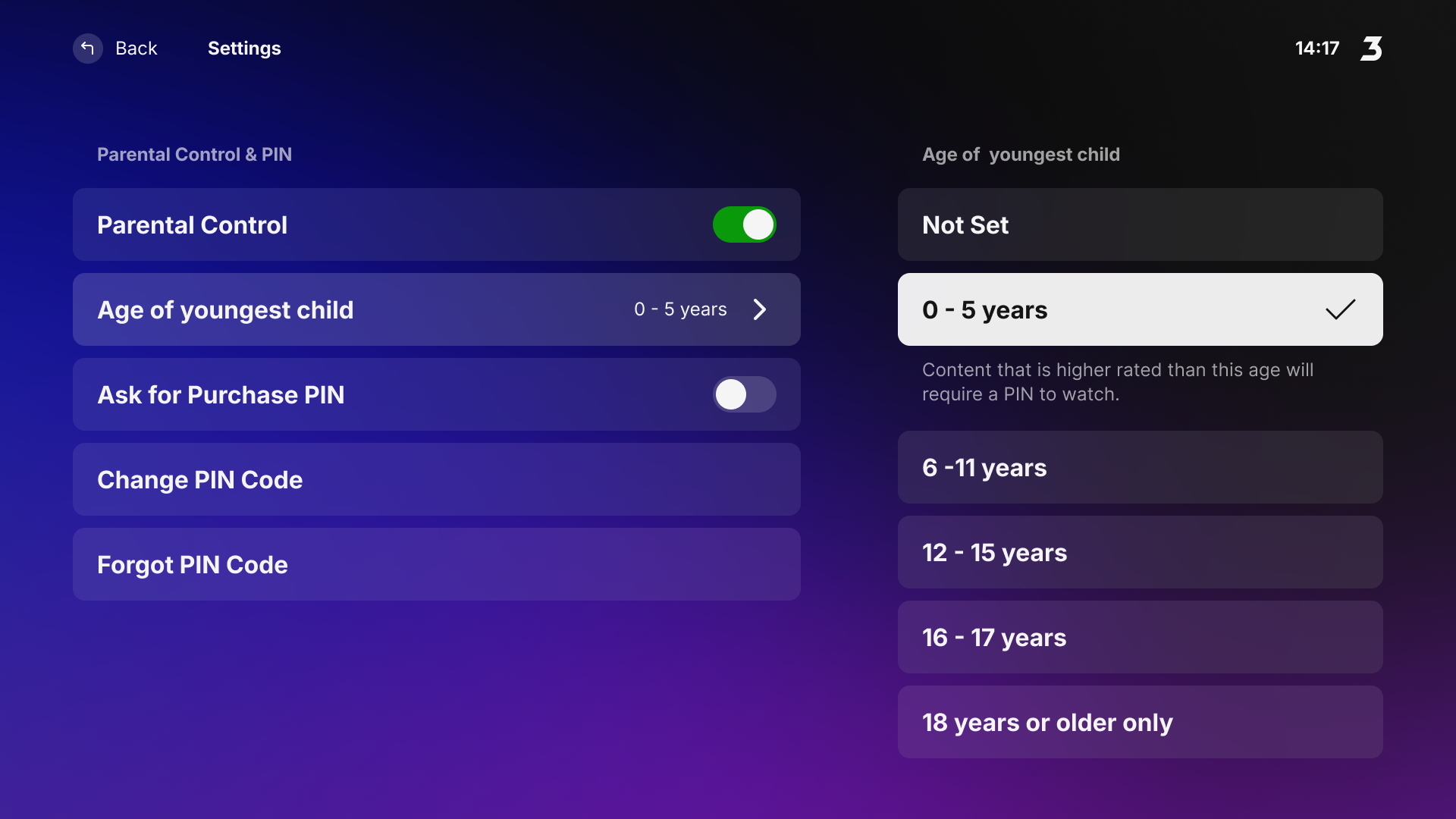
Now live on the 3Ready platform for Android TV devices and operator set-top boxes, Parental Control 3.0 reduces the whole exercise to one question: how old is your youngest child?
Answer it, and the interface reshapes itself. Only content appropriate for that age surfaces, because the platform maps the age to the official rating scheme of the country the service operates in, whether that is FSK in Germany, BBFC in the UK, or Kijkwijzer in the Netherlands.
What should operators look for in a unified TV and VOD platform?
A unified TV and VOD platform should give operators three non-negotiable things:
3Ready, the 3SS platform behind operator deployments across Europe, was built on that principle, and Parental Control 3.0 is its latest expression: one platform, one Control Center, and country-correct compliance in every market a service launches in. Operators manage the age rating mappings centrally, so a new market launch means configuring a scheme rather than rebuilding a feature. For the parent, this setup takes about 30 seconds.
The counterintuitive result is a larger children's offering rather than a smaller one. Without reliable age filtering, the only safe space is a walled-off kids’ mode with a fraction of the catalogue. With it, the child gets the real home screen, the editorial rows, and every title that fits their age. The safest version of the service is also the one with the richest offer for its youngest viewers.
Trust is the retention metric nobody dashboards
The business case reads plainly. A parent who trusts the remote hands it over, and a child who grows up inside the operator's interface anchors the household for years. Compliance teams get verifiable alignment with national rating schemes in every market, which removes a recurring blocker in multi-country launches. And customer satisfaction improves for the least glamorous reason imaginable: the service stopped making parents nervous.
I ran the test at home the week the feature went live. I set the age to five, handed over the remote, and went back to the hob. Nothing followed me into the kitchen. No shout from the sofa, no trailer that had no business being there, no tablet negotiation. If a parent in any of your markets can do the same, the tablet stays in the drawer, and the biggest screen in the house stays yours.
Meet us at IBC 2026 to experience Parental Control 3.0 and the rest of the 3Ready platform live.





.jpg)